

Our Approach
The Difference Between Automation and Transformation
A Customer-First, Tailored Approach That Works
Successful digital HR transformations are shaped long before implementation begins. We bring a product mindset to Phase 0 planning—focusing early on business outcomes, user needs, governance, sequencing, and value realization—so leaders can make confident decisions and mobilize stakeholders and partners with greater clarity and lower risk. Because transformation needs differ, we tailor this approach to the engagement at hand, whether the priority is moving to the cloud, becoming skills-powered or turning around an existing project. The engagement scenarios below illustrate how this foundation can be applied to different transformation contexts.
Engagement Scenarios:
-
For organizations that are between hires and need a Transformation Lead embedded in their team to maintain continuity.
We provide leadership to support you wherever you are on your transformation journey: aligning leadership, mobilizing a PMO, navigating discovery and pre-implementation planning, or providing delivery assurance support during implementation and sustainment.
-
Digital change and transformation initiatives are typically complex and expensive investments. They should have a preliminary business case to ensure ‘the juice is worth the squeeze’ and, if approved, that they are set up for success with sufficient resources.
We help organizations build an evidence-based case for change that is defensible and compelling. We begin with the program vision, transformation readiness assessment, and follow with a review of the HR operating model and technology landscape.
-
Phase Zero projects include multi-year program planning and pre-implementation planning. Many organizations lack the experience and capability to run these successfully - allowing for a myriad of issues to surface during Implementation. This is the primary reason why most transformations fail to produce their expected results.
We help organizations take the necessary steps to plan for transformation success.
-
Transitioning from legacy ways of working to cloud-based HR platforms and operating models.
This engagement typically includes business case development, readiness and risk assessments, target operating model design, roadmap development, governance design, and support for platform selection and mobilization to help the organization move to the cloud with confidence.
-
Helping organizations become skills-powered by strengthening capabilities, roles, and workforce strategies.
This engagement can include skills strategy development, role and capability mapping, workforce planning, job architecture alignment, learning and change enablement, and the design of governance and measures needed to embed a skills-based model into day-to-day decision-making.
-
Optimizing existing HR technology environments to improve adoption, delivery, and value.
Services often include current-state assessments, backlog and enhancement prioritization, service delivery and process redesign, adoption analysis, release and governance improvements, and targeted interventions to improve experience, efficiency, and business value from existing investments.
-
Integrating disparate HRIS solutions that result from a merger or acquisition to create a more coherent, efficient, and scalable HR technology environment.
This engagement typically includes current-state architecture assessment, application and process rationalization, data and integration strategy, target-state design, migration and sequencing planning, governance alignment, and change support to help unify inherited HR platforms while reducing complexity and disruption.
-
Stabilizing high-visibility programs where leaders need a clearer path to outcomes and value.
This engagement generally includes rapid issue and risk diagnostics, executive reporting support, PMO strengthening, governance reset, decision support, delivery coaching, and focused action plans to restore momentum, reduce noise, and create a credible path forward.
-
Supporting reimplementation efforts when organizations need to reset, simplify, or modernize their approach.
This work may include root-cause assessment, scope reset, design simplification, governance and decision-rights clarification, delivery recovery planning, vendor and stakeholder alignment, and a phased roadmap to re-establish credibility and position the program for a more successful outcome.
Our Approach
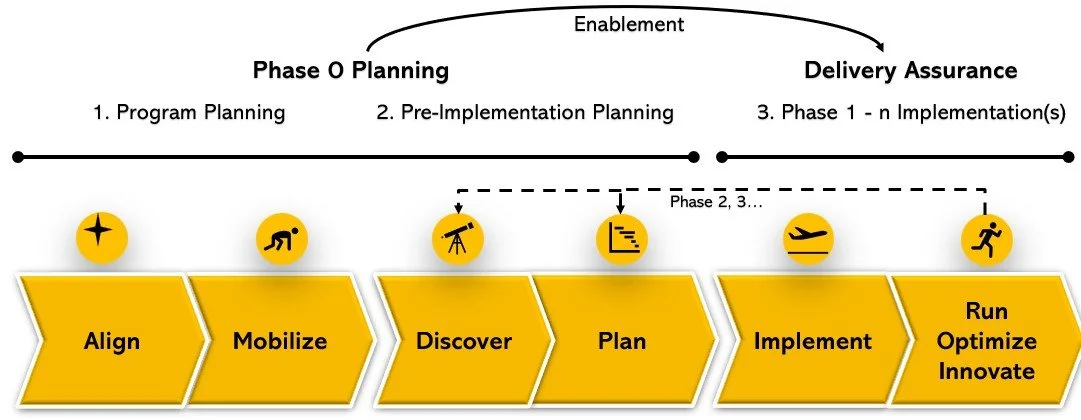
Our three-phase approach helps leaders reduce risk early, make better investment decisions, empower their teams, and realize value faster. Depending on the engagement scenario, we combine strategic program planning, disciplined pre-implementation design and planning, and/or delivery assurance – all grounded in a product mindset (employee centricity, outcome-oriented, continuous improvement, cross-functional collaboration). This helps organizations and their partners move from strategy to execution with greater clarity, control, and business impact.
1
Program Planning
Program planning is often the most consequential phase of a digital transformation. When this work is compressed, organizations can struggle to produce a credible plan that leaders can confidently sponsor and govern. Establishing a product mindset early helps shape the program around business value, user needs, and a sustainable operating model from the start while strengthening digital HR capabilities for the journey ahead.
Align. We align on the vision and transformation readiness with leadership, and define the technology and AI strategy with IT. We then establish a case for change, the governance, delivery model, and roadmap needed to support sound decisions and long-term value. A product mindset keeps investment choices tied to business outcomes through outcome-based prioritization, clear ownership, and roadmap governance. The result is a program charter for executive approval, while laying the foundation for stronger digital HR capabilities over time.
Mobilize. With approval in place, the team establishes the Program Management Office, onboards the core program team, and formally launches the program with stakeholders.
2
Pre-Implementation Planning
Also known as the Discovery Phase, Pre-Implementation Planning defines the right solution and prepares the organization for procurement and implementation. A product management approach strengthens this phase by focusing discovery on user needs, business priorities, and the capabilities required to deliver value over time.
Discover. We use design-thinking methods—including journey mapping, sentiment analysis, and process mapping—to identify current-state pain points and opportunities, define target-state priorities, and establish a clear scope through fit-gap analysis and solution design. Product management practices help sequence capabilities based on user and business value.
Plan. Using the outputs of the Discover stage, the team conducts impact assessments across change, functional, and technical dimensions and develops plans for resourcing, budgeting, and value realization. The outcome is a practical, business-aligned roadmap, budget, and program plan designed to secure sponsor confidence and enable disciplined delivery. These materials are then presented for executive review and approval.
3
Delivery Assurance
Delivery spans implementation, post-go-live support, and ongoing sustainment. A product mindset connects these phases through clear ownership, focused prioritization, and continuous value delivery beyond go-live.
Implementation. During implementation, programs can become overly technology-centric and lose sight of the people, process, and adoption changes required to realize value. A product mindset keeps delivery focused on business outcomes, user experience, and measurable impact.
We work alongside your teams and the system integrator to strengthen execution and reduce risk through focused support in program management, executive reporting, risk management, and capability transfer.
Run, Optimize, Innovate. After go-live, we help stabilize the solution, improve adoption, and strengthen service delivery and the target operating model. A product mindset supports ongoing enhancement prioritization, user feedback, and continuous improvement.
Case Studies
Case studies featuring how we have helped clients with digital transformation success

What we delivered
The engagement focused on uncovering the right skills-based solution and building an implementation case executives could confidently sponsor. This Phase 0 effort established the strategic, operational, and technical foundation for a broader transformation program.
Digital HRx applied its Program Planning and Pre-Implementation Planning methods to align stakeholders, assess options, and define a scalable path forward.
Phase 1 | Program Planning
· Aligned executives and HR leaders on the vision, roadmap, governance, and delivery approach
· Mobilized the core team and established the initial delivery framework and working model
Phase 2 | Pre-implementation Planning
· Led discovery to identify pain points, define opportunities, and prioritize requirements
· Facilitated fit-gap and solution design sessions to validate the future-state model
· Produced recommendations, a high-level roadmap, and an executive case for change
Business outcomes
· Built a compelling executive case for change before committing to a multi-year program
· Identified the core technology, data, and content needed to enable a skills-based model
· Defined the key process and design priorities required for implementation planning
· Surfaced the people, change, and culture factors critical to adoption
Strategic value
The initiative gave executives a practical view of what it would take to become skills-based across technology, operating model, governance, process, and change—providing clearer decisions on value, investment, and implementation path.
The work also highlighted broader opportunities to reduce technical debt, streamline talent processes, and strengthen HR’s role as an owner of digital products and workforce data.
As the organization advances its skills-powered agenda, it is better positioned to enable internal mobility, career development, succession planning, and strategic workforce planning in a constrained labor market.
1. Preparing a Public Sector Corporation to Become a Skills-Based Organization (SBO)
Client challenge
A large public sector organization sought to become a skills-based organization (SBO) to improve workforce agility and compete more effectively for talent. Specifically, they needed to supercharge their internal mobility, career development, and strategic workforce functions. However, they lacked the skills data, digital infrastructure, and internal capability to enable the necessary transformation.
Although a new HRIS had recently been implemented, most transformation expertise exited with that program, leaving HR with limited experience leading a skills-based enterprise transformation.
Why Digital HRx
Digital HRx was engaged to lead Phase 0 planning: align leadership, assess solution options, and define a credible path toward becoming a skills-based organization.
The mandate focused on three priorities:
· Define the vision, case for change, and mobilization approach
· Identify a technical solution aligned to the current platform and business priorities
· Develop an implementation roadmap and case for change

Why Digital HRx
Digital HRx was engaged to help adapt and embed a scalable product operating model that could support transformation and create long-term value.
The mandate was to provide targeted support across three areas:
· Product planning and mobilization
· Operating model design and adoption
· Delivery assurance and risk mitigation
What we delivered
The engagement followed Digital HRx’s three-phase model—Product (Program) Planning, Pre-Implementation Planning, and Delivery—to embed a product-led operating model aligned to the organization’s scale and priorities.
Phase 1 | Product (Program) Planning
· Aligned leaders around a shared product vision, delivery model, charter, and roadmap
· Mobilized a Digital HR PMO, resourcing model, and core delivery frameworks
Phase 2 | Pre-Implementation Planning
· Supported product teams through discovery to identify pain points, define opportunities, and establish employee-centric priorities
· Prepared product teams for implementation through solution design support, planning, and delivery discipline
Phase 3 | Delivery
· Provided governance, delivery assurance, and risk management support across core HR and talent initiatives
Business outcome
· Established a scalable digital HR operating model grounded in product management principles
· Helped build internal capability across Product Leadership, PMO, Change Management, and cross-functional product teams
· Expanded delivery capacity by 2.5× under the new model
· Improved governance, oversight, and proactive risk management across the portfolio
Strategic value
While the engagement began as a brownfield HRIS optimization effort, it created broader strategic value by repositioning HR as an active owner of digital products, with cross-functional product teams accountable for continuous improvement in employee experience and business outcomes.
As employee-centric products are rolled out to global sales teams, the organization is better positioned to convert internal transformation into external value at scale.
2. Embedding a Product Operating Model in a Global Digital HR Team
Client challenge
A global athletic apparel organization was scaling rapidly and needed to improve the employee experience for more than 30,000 employees while enabling stronger customer outcomes worldwide.
The transformation centered on two priorities: introducing a Product Operating Model within Digital HR and modernizing a brownfield HRIS platform that had not undergone meaningful transformation in a decade. Together, these shifts were intended to move HR from a support function to a product-led organization focused on measurable employee outcomes across the lifecycle.
At the outset, the Digital HR team remained organized primarily around functional and technical teams focused on sustaining the existing platform. They had limited experience leading enterprise-scale transformation - particularly through a product-centric model.
3. Accelerating a Global HR Cloud Transformation for a Newly Independent Industrial Equipment Company

Client challenge
A global industrial and agricultural equipment company was preparing to launch a greenfield, cloud-based HR platform as part of its separation from a larger parent organization. The company needed to move quickly while establishing the foundation for a stable, scalable, and globally consistent HR operation for this new 38,000-person organization.
The transformation was designed to achieve four strategic objectives:
1. Rapidly mobilize the program to align leadership priorities and establish a global delivery model
2. Complete pre-implementation planning to define a solution and rollout approach that balanced global consistency with local requirements
3. Deliver a highly complex, multilingual cloud implementation within a year - including time and payroll integrations - to nearly 40,000 employees worldwide
4. Build a self-sufficient Digital HR organization capable of sustaining and evolving the new environment
Collectively, these priorities were intended to reposition HR from an on-premise, transaction-oriented support function to a modern, cloud-enabled service organization operating with a product mindset.
At the outset, the Digital HR team was still primarily organized around functional and technical support of the legacy platform. A new leadership team was recently brought in to stand up the new function, however the team still required transformation and PMO expertise for this this scale, complexity, and visibility.
Why Digital HRx
Digital HRx was engaged to provide transformation and PMO leadership in support of a newly appointed global program lead who reported to the CHRO and CIO. The scope, pace, and complexity of the initiative created a high-risk delivery environment with significant executive visibility. Digital HRx was brought in to help mobilize the program, strengthen execution, and reduce implementation risk across the portfolio.
The mandate focused on three areas:
· Program planning, governance, and mobilization
· Discovery, solution design, and integrated planning across dozens of concurrent projects and workstreams
· Delivery assurance, risk mitigation, and issue resolution across the portfolio of projects
What we delivered
The engagement followed Digital HRx’s three-phase delivery model—Program Planning, Pre-Implementation Planning, and Delivery—to align the solution with the organization’s business priorities and global scale.
Phase 1 | Program (Product) Planning
Aligned program leadership around a shared vision, governance model, program charter, and roadmap
· Helped mobilize the Digital HR PMO, resource model, and core delivery frameworks needed to execute globally
Phase 2 | Pre-Implementation Planning
· Supported workstreams through discovery to identify pain points, define opportunities, and prioritize requirements
· Supported solution design, integrated planning, and delivery discipline across the implementation portfolio
Phase 3 | Delivery
· Provided governance, cross-program reporting, delivery assurance, and proactive risk management across core HR, payroll, and time-related Phase 1 initiatives
Business outcomes
· Established a scalable Digital HR operating model anchored in a product mindset
· Internal capability and capacity developed to launch, stabilize, and sustain Phase 1 while preparing for Phase 2
· Introduced stronger governance, portfolio oversight, and proactive risk management across the transformation program
Strategic value
Although the engagement began as a greenfield HR cloud implementation, it delivered broader enterprise value by helping the organization standardize global processes where appropriate while preserving local flexibility and compliance where necessary. To accommodate higher than expected local requirements for Time & Pay, the go-live was extended 3 months. The company now has a stronger foundation to expand employee-centered services, further mature its Digital HR capability, and reduce operational dependence on its former parent organization.